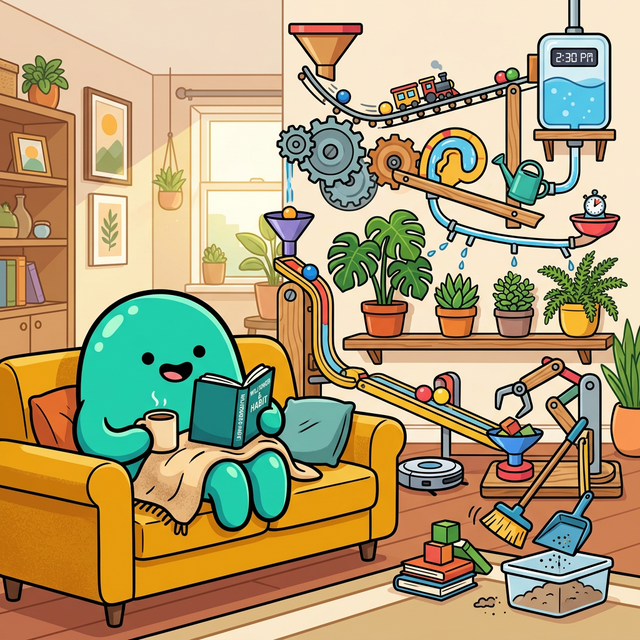
The Willpower Illusion: Why Your Environment Matters More Than Your Discipline
Discover why the world's most disciplined people actually use very little willpower, and how to design your environment to make good habits automatic.
The Willpower Illusion: Why Your Environment Matters More Than Your Discipline
We love the myth of the highly disciplined ascetic. We picture Navy SEALs, Olympic athletes, and successful CEOs as people possessing an almost superhuman reservoir of willpower. We assume that if we just “tried harder” and had more self-control, we too could wake up at 5:00 AM, eat perfectly balanced meals, and never procrastinate.
But behavioral economics presents a very different—and much more comforting—story.
In reality, the people who appear to have the most willpower actually use it the least. They don’t achieve their goals by constantly fighting intense temptations. They achieve them by actively designing an environment where those temptations do not exist.
As behavioral economist Dan Ariely often points out, human beings are highly irrational. We are terrible at resisting immediate gratification. Instead of trying to fix our fundamentally flawed human nature, we need to hack our surroundings.
We need to stop relying on willpower and start relying on environment design.
Willpower as a Depletable Resource
There is a famous psychological concept known as “ego depletion.” The theory suggests that willpower is like a muscle.
Every time you exert self-control—whether it’s holding your tongue during a frustrating meeting, resisting a donut in the breakroom, or forcing yourself to focus on a boring spreadsheet—you drain a little bit of your cognitive battery.
By the time you get home at 6:00 PM, your willpower battery is entirely depleted. So when you have the choice between going for a 30-minute run or sitting on the couch while eating leftover pizza, the couch wins every single time. It doesn’t matter how disciplined you were at 9:00 AM; your cognitive resources are gone.
If willpower is a terrible tool for making good decisions at the end of the day, what should we use instead? We use our environment.
The Principle of Choice Architecture
Dan Ariely’s work in behavioral economics shows that our environment constantly shapes our decisions in ways we don’t even realize. This is known as “choice architecture.”
Supermarkets are brilliant choice architects. The most profitable items (like sugary cereals) are placed exactly at eye level. The essentials (like milk and eggs) are placed at the very back of the store, forcing you to walk past aisles of temptations to get to them.
You can become the choice architect of your own life.
The strategy is incredibly simple: Increase friction for bad habits, and decrease friction for good habits.
If you want to stop checking your phone first thing in the morning, do not rely on your willpower to ignore it when it sits on your nightstand. Instead, increase the friction. Plug your phone charger in the kitchen. Buy a cheap analog alarm clock for your bedroom. When you wake up, the “bad” habit requires you to get out of bed and walk to the kitchen. The environment does the heavy lifting for you.
If you want to read more books, decrease the friction. Place a book directly on your pillow every morning when you make the bed. When you pull back the covers at night, the book is already in your hand.
Default States and the Path of Least Resistance
Humans are biologically wired to take the path of least resistance. We almost always stick with the “default” option.
If a company makes contributing to a retirement fund the default option for new employees (meaning they have to actively choose to opt-out), participation rates skyrocket. If the default option is not contributing, fewer people sign up. The same people are making the decision, but the environment determines the outcome.
To build an optimal environment, make your desired behavior the most obvious, default state.
If you want to eat healthier, the food readily available on your kitchen counter should be apples and bananas, not cookies. If you want to watch less television, take the batteries out of the remote control after every use and place them in a drawer across the room. The sheer annoyance of having to find and insert the batteries will significantly reduce your TV consumption.
Bringing it All Together: The Daily Practice
Environment design isn’t just about physical spaces; it’s also about digital spaces and mental frameworks.
At Becoming, we know that abstract goals are easily ignored. That’s why we created the Daily Practice feature. It acts as a digital environment design tool.
Instead of opening a chaotic to-do list that drains your willpower with overwhelming choices, the Daily Practice feature forces you to select your most important habits before the day begins. It creates a focused, distraction-free environment that guides you through your essential tasks sequentially. You don’t have to decide what to do next; the environment tells you.
When you remove the burden of constant decision-making and rely on a structured, intentionally designed system, the need for willpower evaporates.
Stop trying to become a superhuman who can resist every temptation. Accept your irrational human nature. The secret isn’t striving for perfect discipline; the secret is building a world where doing the right thing takes the least amount of effort.
Design the room, and the room will design you.