Social Proof and Habit Formation: Why Your Circle Determines Your Success
Your habits are contagious. Discover how your social environment shapes your behavior and how to leverage peer influence for transformation.
You start going to the gym. Suddenly, three of your friends join gyms too. Coincidence?
You stop drinking. Your social circle slowly shifts toward people who don’t drink. Magic?
Neither. It’s social proof—the most underestimated force in habit formation.
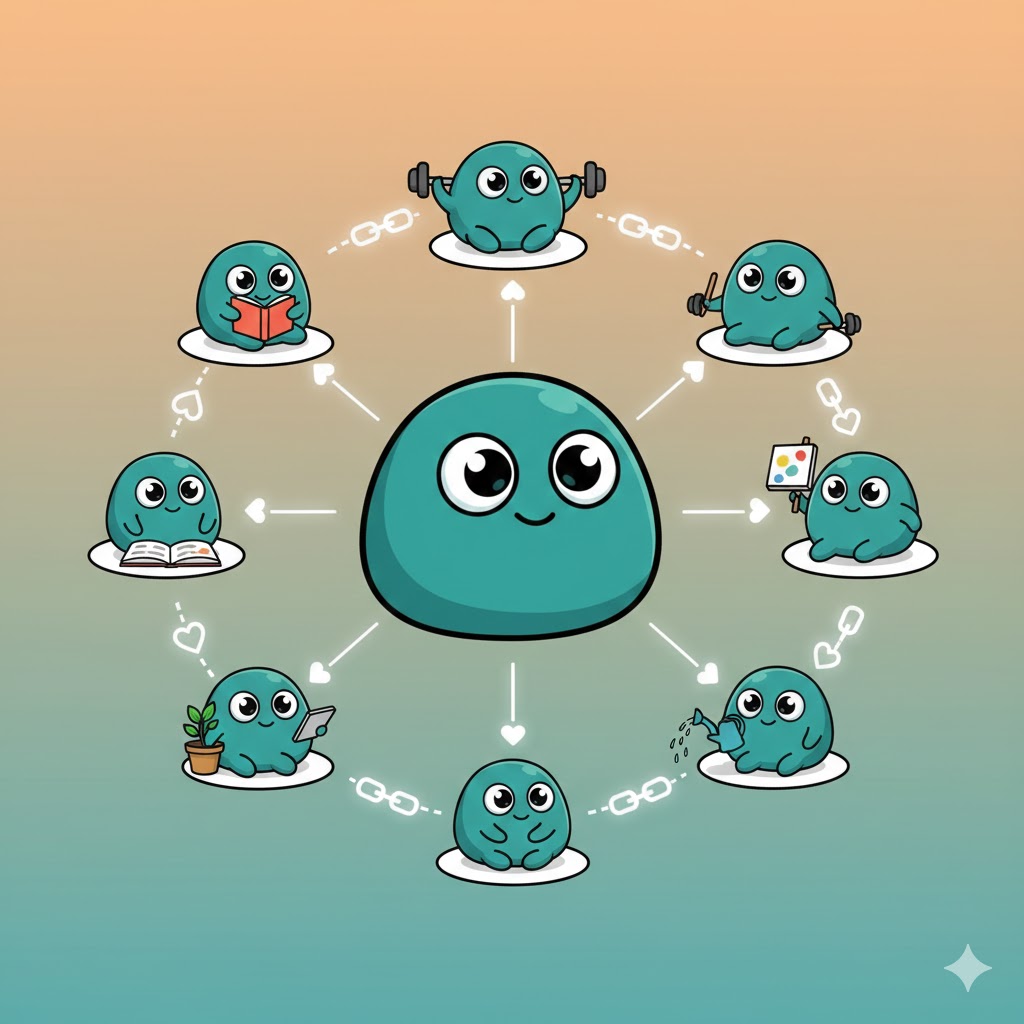
Your habits don’t exist in isolation. They’re constantly influenced by the people around you. And if you’re trying to change yourself without changing your social environment, you’re fighting an uphill battle.
The Framingham Heart Study: Habits Are Contagious
One of the most famous longitudinal studies in social science revealed something startling:
If your friend becomes obese, your risk of obesity increases by 57%.
But it gets more interesting:
- If your friend’s friend becomes obese, your risk increases by 20%
- If your friend’s friend’s friend becomes obese, your risk increases by 10%
Three degrees of separation. People you’ve never met are influencing your habits.
This pattern held for:
- Smoking cessation
- Happiness levels
- Loneliness
- Drinking behavior
The insight: Habits spread through social networks like viruses.
Why We Mirror Those Around Us
Humans are social learners. For millennia, survival depended on mimicking successful behaviors of the group.
Three powerful mechanisms:
1. Mirror Neurons
Your brain has specialized neurons that fire both when you perform an action AND when you observe someone else performing it.
When you watch someone exercise, your motor cortex activates as if you’re exercising. This primes you to copy the behavior.
2. Social Norms
We unconsciously calibrate our behavior to match what’s “normal” in our environment.
If everyone around you reads, reading feels normal. If everyone around you scrolls TikTok, that’s the baseline.
3. Identity Alignment
We adopt behaviors that signal belonging to groups we value.
Example:
- Join a running club → Start identifying as a runner → Run more to maintain group identity
The Hidden Cost of Unsupportive Social Circles
Critical question: Are the five people you spend the most time with living the life you want to live?
If not, you’re swimming against the current.
Common patterns:
- Want to be productive → Friends glorify “hustle culture” or constant distraction
- Want to be healthy → Social group centers around drinking/unhealthy food
- Want to grow → Friends mock self-improvement as “cringe”
You can have willpower. You can have tracking. You can have systems.
But if your social environment actively opposes your identity, transformation is exponentially harder.
The Three Tiers of Social Influence
Tier 1: Immediate Circle (Strongest Influence)
- People you see/talk to daily or weekly
- Family, close friends, partner, roommates
- Impact: 70% of your habit environment
Strategy: If possible, align this circle with your goals. If not possible, create boundaries.
Tier 2: Extended Network (Moderate Influence)
- Colleagues, acquaintances, online communities
- People you interact with regularly but less intensely
- Impact: 20% of your habit environment
Strategy: Curate intentionally. Join communities that embody your desired identity.
Tier 3: Ambient Environment (Subtle Influence)
- Cultural norms, media consumption, internet spaces
- Background social signals
- Impact: 10% of your habit environment
Strategy: Control media diet. Unfollow accounts that don’t align with your identity.
How to Leverage Social Proof for Your Habits
Strategy 1: Join or Create a Habit Tribe
Research shows: People who exercise with a group have 95% higher adherence rates than solo exercisers.
Applications:
- Join a running club (even if you’re slow)
- Find an accountability partner for your writing habit
- Join online communities for your identity (r/fitness, writing groups, etc.)
- Use Becoming with a friend—share streaks and celebrate together
Why it works: The group norm becomes YOUR norm. The behavior feels natural, not forced.
Strategy 2: Make Your Habits Visible
Private habits are easier to abandon. Public habits create accountability.
Examples:
- Tell people about your new identity (“I’m training for a 5K”)
- Post your Becoming streak milestones
- Work out in a public gym (not just at home)
- Share your creations publicly (even if imperfect)
The mechanism: You’ve created social pressure. Your brain wants to maintain consistency with your public declaration.
Strategy 3: Find Your Role Model Proxy
If you can’t change your immediate circle, find a “proxy tribe” that embodies your goals.
Examples:
- Follow people on social media who live your desired identity
- Listen to podcasts by people who have the habits you want
- Read biographies of people who embody your goals
- Watch YouTube creators in your target domain
Why it works: Consistent exposure to the behavior normalizes it in your mind. What once seemed unattainable becomes “just what people like me do.”
Strategy 4: Be the Change in Your Circle
Powerful insight: You don’t just adopt habits from your network. You SPREAD habits to your network.
When you start meditating daily, you give others permission to try it. When you quit drinking, you show others it’s possible. When you build openly, you inspire others to create.
The multiplier: Your transformation can trigger transformation in others, which reinforces YOUR transformation.
The Accountability Partner Framework
One person committed to your success can outweigh an entire unsupportive network.
The ideal accountability partner:
- Pursuing a similar (but not identical) goal
- Both building habits, but potentially different ones
- Similar stage of transformation
- Both beginners, or both building on existing foundations
- Regular check-ins
- Weekly or daily, depending on the habit
- Non-judgmental support
- Celebrates wins, doesn’t shame misses
In Becoming: Share your profile or screenshots. Create a simple accountability loop:
- Monday: “Week 3, still going!”
- Partner replies: “Same, let’s make it to Week 4!”
This simple exchange massively increases completion rates.
The Difficult Conversation: Outgrowing Your Circle
Sometimes, personal growth means social change.
Signs you’ve outgrown your circle:
- They mock your self-improvement efforts
- You feel pulled back into old identities when with them
- Conversations don’t energize or inspire you
- You hide your habits/goals to avoid judgment
This is painful. It’s also necessary.
Options:
- Have honest conversations - Some friends will rise with you
- Create boundaries - Less time together, different contexts
- Peaceful distance - Gradual drift, no drama
- Seek new circles - Add people, don’t just subtract
Remember: Growing apart from people who keep you small isn’t betrayal. It’s self-preservation.
Digital Social Proof: Curating Your Feed
Your digital environment is a social environment.
Audit exercise:
- Open Instagram/Twitter/TikTok
- Scroll for 2 minutes
- Ask: “Do these accounts reflect the person I want to become?”
If no, unfollow ruthlessly.
Replace with:
- Creators who embody your desired habits
- Communities discussing your goals
- Educational content in your growth areas
Your feed should inspire growth, not trigger comparison or distraction.
The Loneliness-Habit Connection
Research shows that lonely people struggle more with habit formation.
Why?
- No social accountability
- No modeling of desired behaviors
- No celebration of wins
- Higher reliance on comfort habits (scrolling, eating, etc.)
The solution isn’t just “make friends.” It’s “be part of a community pursuing something meaningful.”
Options:
- Join a gym/class/club
- Participate in online communities authentically
- Volunteer for causes you care about
- Use apps like Meetup to find interest-based groups
Even digital community counts. The Becoming app is part of a community of people becoming better—you’re not alone.
Becoming’s Social Features (And How to Use Them)
While Becoming focuses on personal accountability, you can add social elements:
1. Share Streaks
- Screenshot your calendar, share with accountability partner
- Creates external motivation
2. Join or Create Communities
- Use Becoming alongside a challenge group
- Weekly check-ins with others using the app
3. Celebrate Publicly
- Milestone posts (“90 days of meditation!”)
- Inspires others, reinforces your identity
The app tracks privately, but you control what you share.
Scientific Insights on Social Habit Formation
The 3% Rule
Research shows that when just 3% of a population adopts a behavior, it gains social momentum. At 10%, it becomes normalized. At 25%, it’s the new default.
Your role: Be in the 3%. Early adopters change culture.
The Bandwagon Effect
People are more likely to adopt behaviors that are visibly growing in popularity.
Application: When promoting habits to others, emphasize growing adoption: “More and more people are…”
The Social Comparison Effect
Upward comparison (seeing people ahead of you) can motivate OR demoralize, depending on mindset.
Healthy comparison: “They’re proof it’s possible. I’m on the same path.” Unhealthy comparison: “They’re so far ahead. I’ll never get there.”
In Becoming: Focus on YOUR progress, not others’. The calendar shows YOUR journey.
The 6-Month Social Environment Audit
Every 6 months, evaluate:
1. Who am I spending the most time with? 2. What habits are they modeling? 3. Are these the habits I want? 4. If not, what needs to change?
Log this in Becoming’s notes. Track correlation between social changes and habit success.
Your action plan
This week:
- Identify one habit you’re struggling with
- Ask: Is my social environment supporting or hindering this?
- Make ONE social change:
- Join a community
- Find an accountability partner
- Curate your digital feed
- Have a boundary conversation
- Track the habit in Becoming for 14 days
- Notice the difference
The Ultimate Social Proof Truth
You will become the average of the people you spend time with.
This isn’t motivational fluff. It’s neurological reality.
Your brain is constantly learning from those around you. If they embody your desired identity, learning is effortless. If they embody the opposite, transformation is a battle.
Choose your circle intentionally. Join communities that lift you. Be the friend who inspires growth.
Track your habits in Becoming. Share your journey with the right people. Watch social proof work FOR you instead of against you.
You’re not just building habits. You’re becoming part of a tribe that becomes better together.