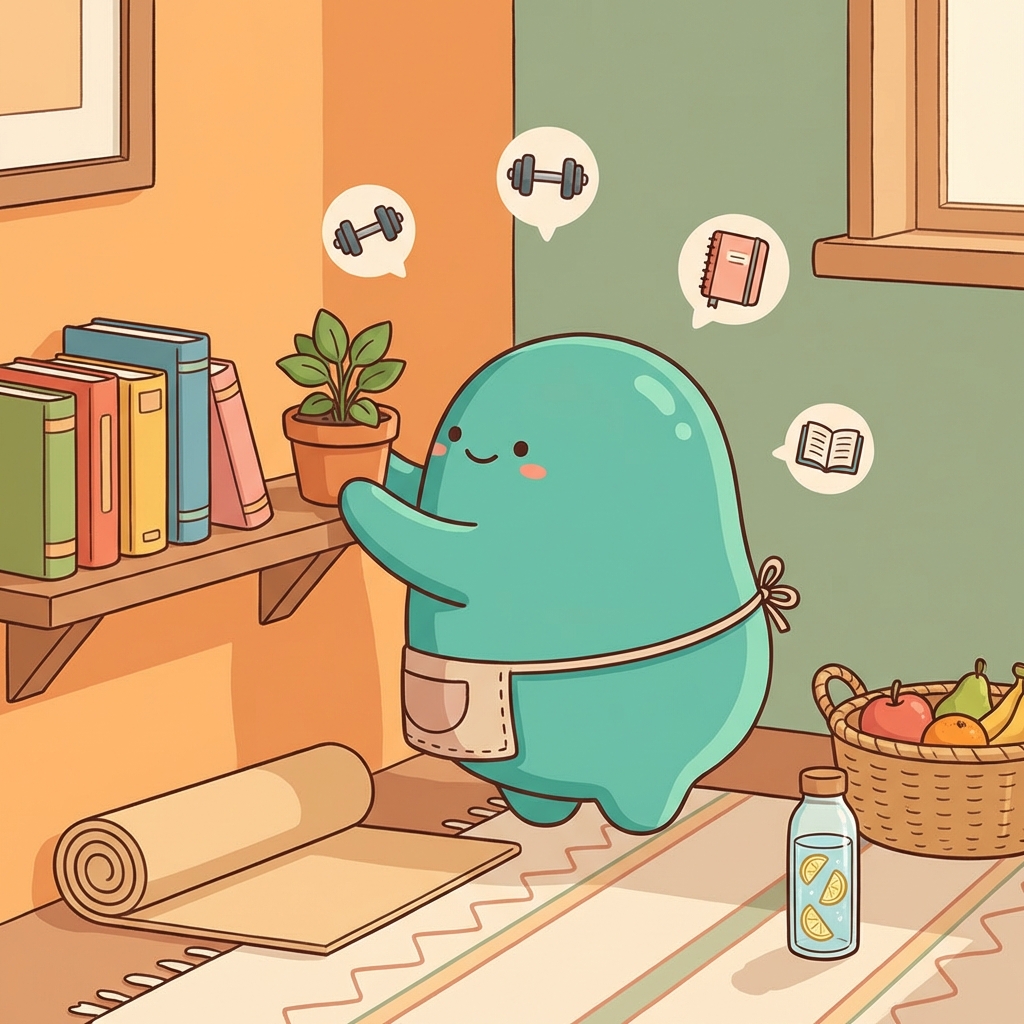
Environment Design: How Your Space Shapes Your Habits
Your environment is invisibly shaping your behavior every moment. Learn how to redesign your space to make good habits inevitable and bad habits impossible.
You walk into your kitchen for water and walk out with cookies. You sit down to work and find yourself scrolling social media. You plan to read before bed but end up watching TV.
This isn’t a willpower problem. It’s an environment problem.
Your space is constantly cueing behaviors—and most of these cues operate below conscious awareness. The good news? Once you understand how environment shapes habits, you can redesign your space to make the right choices automatic.
The Invisible Architecture of Behavior
Every environment is a collection of cues. And every cue triggers a habit loop.
See your running shoes by the door → Think about exercising → Feel motivated (or not) See your phone on the nightstand → Think about checking it → Reach for it automatically
James Clear’s insight: “Environment is the invisible hand that shapes human behavior.”
You don’t choose your actions in a vacuum. Your environment pre-loads the deck.
The Principle of Least Effort
Humans are cognitive misers—we instinctively choose the path of least resistance.
Research from behavioral economics shows:
- People eat 30% more when food is on the counter vs. in the cupboard
- Gym attendance increases 50% when the gym is less than 5 minutes away
- Recycling rates double when bins are more visible
The rule: Whatever requires the least effort is what you’ll do most often.
This means two things:
- Make good habits as easy as possible
- Make bad habits as hard as possible
The Two-Step Environment Redesign
Step 1: Audit Your Cues
Walk through your space and notice what’s visible, accessible, and attractive.
In your bedroom:
- What do you see when you wake up? (Phone? Book? Journal?)
- What’s on your nightstand?
- How easy is it to do your morning habit?
At your desk:
- What’s within arm’s reach?
- What tabs are open by default?
- What’s the first thing you see when you sit down?
In your kitchen:
- What’s at eye level in your pantry?
- What’s on the counter?
- What’s in the front of your fridge?
Each visible item is cueing a behavior. Is it the behavior you want?
Step 2: Redesign for Your Identity
Based on who you want to become, restructure your environment.
If you want to become a reader:
- Put books on your pillow
- Remove TV remote from living room
- Place a book on the breakfast table
If you want to become an athlete:
- Lay out workout clothes the night before
- Keep resistance bands by your desk
- Put running shoes by the door
If you want to become a writer:
- Open a blank document as your default screen
- Remove distracting apps from your home screen
- Keep a journal on your desk
The Four Laws of Environment Design
Law 1: Make It Visible
The more visible the cue, the more likely the habit.
Research shows visual cues are processed 60,000 times faster than text. Your brain spots patterns before you consciously notice them.
Applications:
- Leave your yoga mat unrolled in your bedroom
- Put a water bottle on your desk (not in the kitchen)
- Display your guitar on a stand (not in a case)
In Becoming: Set the app icon somewhere visible on your phone. Visual prominence = mental prominence.
Law 2: Make It Attractive
The more attractive the cue, the more motivated you feel.
Humans are drawn to aesthetic environments. Research shows people are more likely to use spaces they find visually appealing.
Applications:
- Buy beautiful vegetables (you’ll want to eat them)
- Get a nice journal (you’ll want to write in it)
- Create a meditation corner with plants and soft lighting
The principle: Don’t just make it functional. Make it delightful.
Law 3: Make It Easy
Reduce friction by at least 20 seconds.
A Princeton study found that reducing friction by just 20 seconds dramatically increases follow-through.
Applications:
- Pre-portion healthy snacks on Sunday
- Set out breakfast items the night before
- Keep dumbbells next to your couch (not in the garage)
The inversion: Add 20 seconds to bad habits. Put your phone charger in another room. Delete social apps (force re-login). Unplug the TV.
Law 4: Make It Satisfying
Create immediate visual progress.
Delayed rewards don’t motivate. Immediate feedback does.
Applications:
- Use a visible habit tracker (calendar with Xs)
- Put completed books on a visible shelf
- Display your running shoes after workouts (evidence of effort)
In Becoming: The checkmark is immediate satisfaction. The streak counter is visual progress. These aren’t superficial—they’re neurochemical triggers.
Context-Specific Habits
Here’s a powerful insight: Habits are often context-dependent.
You might be disciplined at the office but not at home. Focused in the library but scattered in your apartment.
Why? Different environments cue different behaviors.
The solution: Create dedicated spaces for dedicated behaviors.
- Reading corner: Only ever read there
- Work desk: Only ever work there (not eat, not scroll)
- Meditation cushion: Only ever meditate there
Over time, the context itself becomes the cue. Walking to your reading corner triggers reading mode automatically.
The Fresh Start Effect: Use Transitions
Research on the “fresh start effect” shows behavior change is easier during transitions:
- Moving to a new home
- Starting a new job
- After vacation
- New season
Why? Old environmental cues are disrupted. You get to build new cue-behavior associations.
Practical use: When anything in your environment changes, intentionally redesign for your new identity.
Common Environment Mistakes
Mistake 1: Relying on Willpower Over Design
“I just need to stop snacking” → But there are cookies on the counter.
Fix: Remove the cue. No cookies in the house = no decision to make.
Mistake 2: One-Size-Fits-All Advice
“Everyone should have a morning routine at a desk.”
Fix: Design for YOUR life. Night owl? Different design. Small apartment? Different solutions.
Mistake 3: All-or-Nothing Redesign
“I need to completely overhaul everything!”
Fix: Change one thing this week. Then another next week. Compound changes.
Mistake 4: Ignoring Shared Spaces
You optimize your space, but you live with others who don’t share your habits.
Fix: Create personal zones within shared spaces. Your drawer. Your shelf. Your corner.
The Phone Problem: Your Most Powerful Environment
Your phone is your most immediate environment. It’s with you 24/7, and it’s cueing behaviors constantly.
The harsh truth: If Instagram is on your home screen, you’re designing for distraction.
The environment redesign:
- Delete time-wasting apps (or require re-login each time)
- Move Becoming to your home screen, front and center
- Use app limits and grayscale mode
- Charge your phone outside your bedroom
Your phone’s environment shapes hours of daily behavior. Optimize it ruthlessly.
Becoming’s Role: Your Digital Environment
Becoming is part of your digital environment—and it’s designed to cue the right behaviors:
Visual Cues:
- Daily notification at your chosen time
- App icon prominence
- Calendar with visual patterns
Friction Reduction:
- One-tap habit logging
- No complex menus
- Fast, simple interface
Immediate Satisfaction:
- Instant checkmark
- Streak updates
- Visual progress
Every design choice is intentional. The app IS the environment.
Your Environment Action Plan
This week:
- Choose one identity you’re building
- Identify one environmental cue that supports it
- Make it visible, attractive, and easy
- Track the habit in Becoming for 7 days
- Notice the difference
Example:
- Identity: “I am a reader”
- Cue: Book on pillow
- Action: Read one page before sleep
- Track in Becoming
- Notice: After 7 days, does reading feel more automatic?
The Ultimate Environment Truth
You do not rise to the level of your goals. You fall to the level of your environment.
Willpower is finite. Environment is constant.
Stop fighting yourself. Start designing your space.
Your environment should make good habits the path of least resistance—and bad habits nearly impossible.
Redesign your space. Track your habits in Becoming. Watch yourself transform without willpower.
Your environment is working for you or against you. There is no neutral.
Choose wisely.