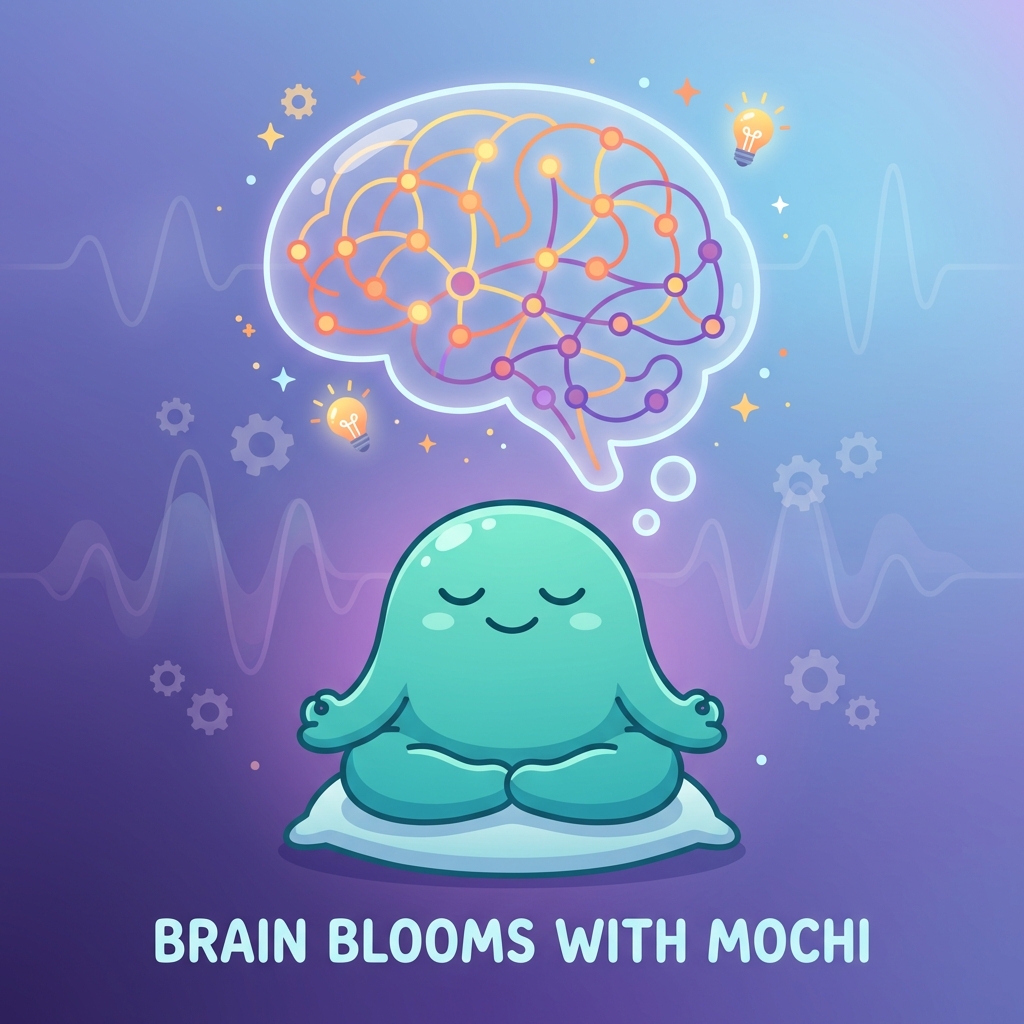
The Neuroscience of Habit Formation: Your Brain on Autopilot
Understand what actually happens in your brain when you build a habit, and how to leverage neuroscience to make lasting change effortless.
Ever wonder why brushing your teeth feels automatic but meditation still requires conscious effort, even after weeks of practice?
The answer lies in your brain’s extraordinary ability to rewire itself—a phenomenon called neuroplasticity. Understanding this process doesn’t just satisfy curiosity; it gives you a roadmap for building habits that truly stick.
Your Brain: The Ultimate Efficiency Machine
Your brain uses about 20% of your body’s energy despite being only 2% of your body weight. To conserve resources, it constantly seeks to automate repeated behaviors.
This is why you can drive home from work while thinking about dinner—your brain has moved driving to autopilot, freeing up mental energy for other tasks.
The technical term: Your brain is shifting tasks from the prefrontal cortex (conscious decision-making) to the basal ganglia (automatic patterns).
The 3 Stages of Habit Formation (In Your Brain)
Stage 1: The Cognitive Stage (Days 1-10)
Brain Region: Prefrontal Cortex (PFC)
When you start a new habit, your PFC is working overtime:
- Consciously remembering to do the behavior
- Overriding competing desires
- Evaluating whether you’re doing it “right”
What this feels like: Hard. Exhausting. Like you’re fighting yourself.
What’s actually happening: Your brain is laying down new neural pathways. Every repetition makes these pathways slightly stronger.
Stage 2: The Associative Stage (Days 10-30)
Brain Regions: PFC + Basal Ganglia
Your brain starts detecting patterns:
- “After coffee, we do this behavior”
- “When I feel stressed, this is what I do”
- “This action leads to this reward”
The basal ganglia begins taking over parts of the process, but the PFC is still supervising.
What this feels like: Easier than before, but still requires attention. Some days it feels automatic; other days you’re back to forcing it.
What’s actually happening: Neural pathways are strengthening. The behavior is becoming “chunked”—your brain groups the individual steps into one automatic sequence.
Stage 3: The Autonomous Stage (Day 30+)
Brain Region: Primarily Basal Ganglia
The habit is now encoded in your brain’s automatic systems. The behavior triggers with minimal conscious thought.
What this feels like: Natural. Effortless. You feel weird not doing it.
What’s actually happening: The neural pathway is now myelinated—wrapped in a protective coating that makes signals travel faster. The habit is on autopilot.
The Role of Dopamine: Your Brain’s Motivation Currency
Dopamine isn’t the “pleasure chemical”—it’s the anticipation and reinforcement chemical.
Here’s how it works in habit formation:
Initial Stage: Your brain releases dopamine after the reward (e.g., feeling good after exercise).
Developing Habit: Dopamine shifts to the cue (e.g., seeing your running shoes triggers dopamine).
Established Habit: Dopamine is released in anticipation, making you want to do the behavior.
This is why:
- Athletes crave their workout
- Writers feel compelled to write
- Meditators miss their practice when they skip
Their brains have rewired to anticipate the reward. The behavior itself becomes intrinsically motivating.
The 21-Day Myth: How Long Does It Really Take?
You’ve probably heard “it takes 21 days to form a habit.” This comes from a misinterpretation of Dr. Maxwell Maltz’s work with plastic surgery patients.
The actual science: A 2009 study by Phillippa Lally at University College London found:
- Simple habits (drinking water) averaged 18 days
- Complex habits (exercise) averaged 66 days
- Range for all participants: 18 to 254 days
The key insight: It depends on:
- Complexity of the behavior
- Consistency of practice
- Environmental cues
- Personal neurochemistry
This is why Becoming doesn’t push you to hit arbitrary day counts. Instead, it tracks cumulative evidence that you’re becoming this person, regardless of timeline.
Neuroplasticity: Your Brain’s Superpower
Here’s the incredible part: Your brain physically changes based on what you repeatedly do.
London Taxi Drivers: Studies show their hippocampus (spatial navigation) is significantly larger than non-drivers.
Musicians: Have enhanced auditory cortex development and increased motor cortex density.
Meditators: Show increased gray matter in areas related to emotional regulation and self-awareness.
The same principle applies to your habits. Every time you practice a behavior, you’re literally sculpting your brain.
This isn’t metaphor—it’s neuroscience.
How to Hack Your Brain for Habit Success
1. Cue Consistency
Your basal ganglia learns patterns through consistent triggers.
Application: Use the same cue every time. “After coffee” works better than “sometime in the morning.”
In Becoming, link habits to specific times or post-habit triggers. This gives your brain the consistency it needs to automate.
2. Immediate Rewards
Dopamine is released when reward closely follows action.
Application: Don’t wait for long-term results. Create immediate micro-rewards.
Becoming provides this automatically—the checkmark, the streak counter, the visual proof. These trigger dopamine now, not months from now.
3. Minimize Cognitive Load
Your PFC has limited capacity. The easier you make the habit, the less it has to work.
Application: Start with behaviors so small they require almost no willpower.
This is the Two-Minute Rule in action. By reducing PFC demand, you accelerate the transfer to basal ganglia automation.
4. Pattern Recognition
Your brain loves patterns. Give it clear ones.
Application: Track your habits visually. Your brain will recognize the pattern and want to continue it.
Becoming’s calendar view shows your consistency pattern at a glance, leveraging your brain’s pattern-matching instincts.
The Dark Side: How Bad Habits Form
Unfortunately, your brain can’t distinguish between “good” and “bad” habits. It just automates what you repeat.
Scrolling social media when bored follows the exact same neurological pathway as reading when bored.
The difference? You’ve practiced one more than the other.
Good news: This means you can rewire bad habits using the same mechanisms:
- Identify the cue (boredom)
- Replace the routine (scroll → read)
- Maintain the reward (stimulation/information)
Same cue, same reward, new routine. Your basal ganglia will learn the new pattern with consistent practice.
Why Tracking Accelerates Neuroplasticity
Studies show that tracking behavior enhances habit formation through multiple mechanisms:
1. Attention Focus: Tracking directs conscious attention to the behavior, strengthening initial neural encoding.
2. Feedback Loop: Seeing your progress provides immediate positive reinforcement (dopamine).
3. Pattern Visibility: Visual tracking helps your pattern-recognition systems identify and reinforce the habit loop.
This is why Becoming isn’t just an app—it’s a neuroplasticity accelerator. Every time you log a habit, you’re:
- Reinforcing the neural pathway
- Triggering dopamine
- Creating visual evidence
- Building identity alignment
Your Brain Wants You to Succeed
Here’s the counterintuitive truth: Your brain isn’t fighting against you. It’s trying to help.
When you feel resistance to a new habit, that’s not weakness—that’s your brain protecting limited resources. It hasn’t yet recognized this behavior as worth automating.
Your job is to give it consistent evidence that this habit serves you. Do this enough times, and your brain will shift it to autopilot.
Then the behavior that once required willpower becomes the behavior that requires willpower not to do.
From Conscious Effort to Unconscious Mastery
The journey from “I have to force myself” to “I can’t imagine not doing this” is a neurological transformation.
You’re not building discipline. You’re building brain architecture.
Every rep is a signal to your neurons: “This matters. Wire this in.”
Use Becoming to track every signal you send. Watch your brain rewire itself, one habit at a time.
You’re not just changing your behavior. You’re literally changing your brain.
And that’s the most powerful transformation of all.