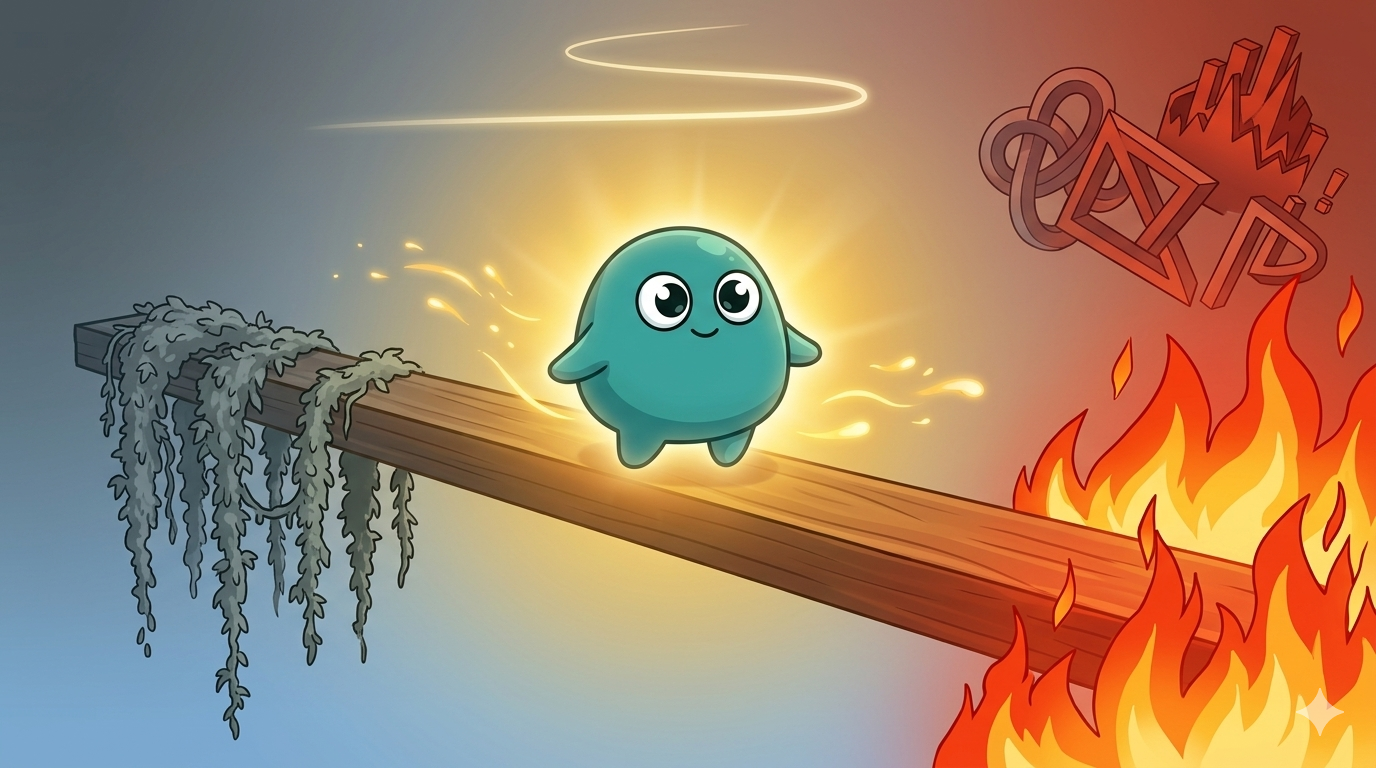
The Goldilocks Rule: Why Just-Right Challenges Keep You Showing Up
The Goldilocks Rule explains why habits collapse when they're too easy or too hard — and how optimal challenge triggers the flow state that makes consistency effortless.
Most people think habits fail because they lack discipline. The real culprit is usually boredom — or overwhelm. And the line between them is thinner than you’d expect.
The Goldilocks Rule, popularized by James Clear in Atomic Habits, captures a deceptively simple truth: humans are most motivated when working at the edge of their current ability. Not coasting. Not drowning. Just right.
This isn’t self-help intuition. It’s grounded in decades of psychological research — and understanding it changes how you design habits that last.
What the Goldilocks Rule Actually Means
Mihaly Csikszentmihalyi, a Hungarian-American psychologist, spent decades studying peak performance and happiness. His landmark work on flow — that absorbed, effortless state where time disappears — revealed a consistent pattern: flow emerges when challenge and skill are roughly matched.
Too easy: your mind wanders. You check your phone. The habit feels pointless. Too hard: you feel anxious, incompetent, and you quit. Just right: you’re engaged, slightly stretched, and intrinsically motivated to continue.
Csikszentmihalyi’s research showed this isn’t a personality trait — it’s a neurological response. When a task sits at that sweet spot, roughly 4% beyond your current competence, the brain releases the exact chemical cocktail — dopamine, norepinephrine, serotonin — that feels like meaning in motion.
This is the foundation of the Goldilocks Rule as applied to habit design.
Why Most Habit Systems Get This Wrong
Most goal-setting advice pushes toward extremes. “Dream big” produces habits that are too ambitious. “Start small” (while useful) can push habits that are too trivial to feel worth doing after week two.
When a behavior no longer produces any psychological reward — no challenge, no satisfaction, no growth signal — it drifts toward automatic background noise and eventually stops altogether.
James Clear frames this with brutal clarity: “The greatest threat to success is not failure but boredom.”
A 2021 study in the Journal of Personality and Social Psychology found that participants who rated their habits as “moderately challenging” showed 2.4x the six-month adherence rate compared to those who rated habits as “very easy.” The easy-habit group didn’t feel lazy — they felt like what they were doing no longer mattered.
The Goldilocks Rule isn’t about making things harder arbitrarily. It’s about calibrating difficulty to your current level — and adjusting that calibration as you grow.
How to Find Your Goldilocks Zone
The practical question is: how do you know when a habit is just right?
Three signals to watch for:
Mild resistance without dread. A Goldilocks habit should feel like something you have to slightly push yourself to start, but that you rarely regret doing. If you dread it every single day, it’s too hard. If it’s purely automatic with zero engagement, it’s too easy.
The absorption signal. Csikszentmihalyi’s flow research consistently found one marker: time distortion. When you lose track of time during a habit, you’re in the zone. When you’re watching the clock, you’re out of it — either bored or overwhelmed.
Post-completion satisfaction. A Goldilocks habit leaves a mild sense of accomplishment, not relief that it’s over. That satisfaction is your brain’s feedback that the difficulty was calibrated correctly.
In Becoming, you can track this qualitatively over time. When you notice a habit has become too automatic (no longer earning that satisfaction signal), it’s a clear sign to raise the difficulty — add a rep, a minute, a layer of complexity.
The Identity Dimension of Optimal Challenge
Here’s where the Goldilocks Rule connects to something deeper than motivation science.
Self-determination theory, developed by Edward Deci and Richard Ryan at the University of Rochester, identifies three core psychological needs that drive intrinsic motivation: autonomy, competence, and relatedness. The Goldilocks Rule directly feeds competence.
Every time you complete a habit at the edge of your ability, you’re not just building a skill — you’re casting a vote for a specific identity. The runner who adds 0.5 km to their route. The writer who adds five minutes to their session. The meditator who sits through the restlessness a little longer.
These micro-stretches accumulate. Over months, the person who started with a five-minute morning run may be training for a half marathon — not because they were forced to, but because each Goldilocks moment built evidence for who they’re becoming.
This is the mechanism behind identity-based habit formation: difficulty that’s calibrated correctly creates competence experiences, which revise your self-concept, which sustains motivation without relying on willpower.
Practical Calibration: The 10% Stretch
A reliable rule of thumb: when a habit feels fully comfortable for two consecutive weeks, add approximately 10% more challenge.
- Journaling 5 minutes? Try 5.5.
- Doing 10 push-ups? Try 11.
- Meditating for 10 minutes? Try 11, with slightly less guidance.
The percentage matters less than the principle: small, consistent recalibration keeps you in the Goldilocks zone without triggering the anxiety spiral that comes from large jumps.
BJ Fogg’s Tiny Habits research at Stanford echoes this — his participants who consistently scaled habits upward (what he calls “growing your habit”) showed dramatically higher long-term adherence than those who maintained a fixed routine indefinitely. The fixed routine doesn’t fail on day 3. It fails on day 47, when boredom sets in.
Frequently Asked Questions
Is the Goldilocks Rule the same as progressive overload in fitness?
Very similar. Progressive overload — gradually increasing weight, reps, or intensity — is essentially the Goldilocks Rule applied to physical training. The same neurological principle applies: your system adapts to current challenge levels and needs incremental escalation to stay engaged. The difference is that the Goldilocks Rule applies to any habit, not just physical ones.
What if I genuinely don’t feel challenged but I’m still consistent?
Consistency without challenge is fine for maintenance habits — brushing your teeth doesn’t need to get harder. But for growth habits — the ones tied to identity development and skill building — a total absence of challenge is a signal that the habit has served its bootstrapping purpose and may be ready to evolve into something more demanding.
How do I apply this when motivation naturally fluctuates?
On low-energy days, deliberately lower the difficulty. Not to zero — just slightly easier than your Goldilocks baseline. This keeps the neural pathway active without triggering overwhelm. On high-energy days, push slightly past your comfortable edge. Csikszentmihalyi’s research shows that even brief flow experiences on good days can “bank” motivation that carries through harder periods.
The Bottom Line
The Goldilocks Rule reframes the habit-motivation relationship. You don’t need more willpower — you need better calibration. Match the difficulty of your habit to the edge of your current ability, and you activate the intrinsic motivation system that makes humans love to get better at things.
The people who maintain habits for years aren’t more disciplined. They’re better at finding the just-right challenge that makes showing up feel worth it.
Start where you are. Stretch slightly. Adjust as you grow. That’s the full formula.
Ready to track where you’re challenging yourself and where you’re coasting? Start building identity-based habits in Becoming →
Related reading: The Science of Sustainable Motivation · Why You Keep Breaking Habits · The Two-Minute Rule